0
0

Ultimate (CHNS) Analysis: Determining Elemental Composition of Materials
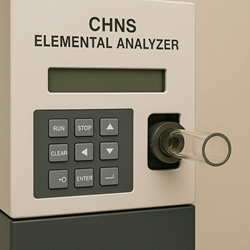
Ultimate (CHNS) analysis is an essential analytical technique used to determine the carbon (C), hydrogen (H), nitrogen (N), and sulfur (S) content in organic and inorganic materials. It provides critical data on the elemental makeup of fuels, soils, biomass, food, pharmaceuticals, and polymers, supporting quality control, environmental monitoring, and research applications.
The technique involves combustion of the sample at high temperatures, converting elements into measurable gases (e.g., CO₂, H₂O, N₂, SO₂). These gases are quantified using detectors, allowing precise calculation of each element’s percentage composition. Combined with proximate analysis, CHNS testing helps in energy content determination, pollution studies, and raw material evaluation.
Key applications include:
Fuel and energy research: Evaluating coal, biofuels, and waste-to-energy materials for calorific value and emissions control.
Environmental studies: Determining nitrogen and sulfur content in soils and sediments to assess fertility and pollution levels.
Food and pharmaceuticals: Measuring protein (nitrogen) and other elemental compositions for quality assurance.
Material science and polymers: Characterizing raw materials for manufacturing and research.
Ultimate CHNS analysis is widely adopted due to its accuracy, repeatability, and compliance with ASTM, ISO, and EPA standards, making it a core method in industrial and laboratory elemental testing.

Online Payment
Sent to Email
Secure and reliable laboratory testing services, fast turnaround.